Fortezza Artifact Multi-Asset Growth Index: Recap After 3 Months
When we launched the Fortezza Artifact Multi-Asset Growth Index in January, our objective was to bring the logic behind Barudion’s Pro Portfolio into a cleaner, more investable format: an exchange-listed strategic certificate, issued with Fortezza Finanz AG and Vontobel, that follows the same regime-adaptive core process while reducing the frictions of manual replication. That public wrapper allows us to continuously extend and improve the strategy (such as by adding a broad commodities sleeve), while at the same time achieving materially better implementation efficiency than a do-it-yourself portfolio of leveraged products.
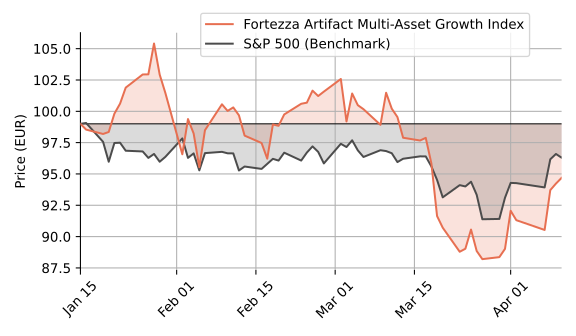 Figure 1: Since-launch performance of the certificate versus the S&P 500 benchmark. Since 15 January 2026, the Fortezza Artifact Multi-Asset Growth Index initially moved ahead of the S&P 500 benchmark, then experienced a sharp March drawdown before recovering into early April. Chart based on daily Onvista close prices through 10 April 2026.
Performance
The Fortezza Artifact Multi-Asset Growth Index was issued on 12 January, and active position management started on 15 January. This timing meant that the certificate did not begin trading in a benign environment. It entered the market amid slowing growth, incomplete disinflation, and renewed trade-policy volatility. In the United States, real GDP growth for the fourth quarter of 2025 slowed to 0.7% annualized, January CPI still stood at 2.4%, and the Federal Reserve kept rates unchanged while stating that inflation remained “somewhat elevated.” Markets were then hit by renewed tariff turbulence: on 20 January, Wall Street suffered its biggest one-day decline in three months on fresh tariff threats, and on 20 February the U.S. administration shifted to a temporary 10% global tariff after the Supreme Court struck down the earlier emergency-tariff framework.
Even in these unsettled market conditions, the certificate initially proved resilient. In the first phase after trading began, it benefited from the fact that the starting allocation was not narrowly dependent on a single risk regime, but already combined equity participation with meaningful exposure to gold and a substantial cash reserve. As a result, the strategy was able to hold up well during the early tariff-driven volatility and, for much of the period, trade at or above the benchmark despite the sharp swings in broader markets (see Figure 1).
| Metric | Certificate | S&P 500 benchmark |
|---|---|---|
| Return since 15 Jan 2026 | -4.35% | -2.73% |
| Peak from launch | +6.47% | +0.07% |
| Max drawdown | -16.33% | -7.76% |
| Annualized volatility* | 28.23% | 14.76% |
| Trading days at or above benchmark** | 43 / 60 | — |
Table 1: Performance statistics since launch.
* Annualized from a short live sample and therefore indicative rather than long-run.
** On a normalized basis, including the first observation.
The decisive regime change then came with the Iran conflict. After the attacks of 28 February, Iran effectively closed the Strait of Hormuz, and the IMF warned that the war would lead to higher inflation and slower global growth. Reuters reported that the conflict trapped nearly a fifth of the world’s oil and gas flows, while around 11 million barrels per day of oil production and Qatar’s LNG output were forced offline during the six-week war. For a multi-asset strategy like ours, that was the key development of the quarter: the market was no longer dealing merely with softer growth and tariff noise, but with an outright energy shock that altered inflation expectations, rate assumptions, and cross-asset correlations at the same time. The immediate consequence was a marked drawdown in March (see Figure 1 & Table 1), as markets repriced abruptly, and much faster than our update interval, across several asset classes.
Allocation changes
That drawdown must be viewed in context. A monthly strategy built on weekly data is not designed to eliminate every abrupt market break in real time, and drawdowns of this magnitude remain within the range that can be expected when regimes shift suddenly and multiple asset classes reprice at once. What is more relevant is that the recent weight changes reflect the current macroeconomic setting in a coherent manner: commodities, including oil and gas products, have been increased; equities and gold have been reduced; and the cash position has been raised materially to provide additional protection against fast-moving dislocations. Taken together, these adjustments indicate that the model currently interprets markets as being in a prolonged phase of regime uncertainty. In such an environment, it is appropriate for the algorithm to reduce overall risk, broaden diversification across asset classes, and maintain a healthy cash reserve until a more stable regime becomes visible.
| Asset | 12 Jan 2026 | 6 Apr 2026 | Change |
|---|---|---|---|
| 3x Stocks | 39.1% | 25.5% | -13.6 pp |
| 3x Treasuries | 2.1% | 1.8% | -0.3 pp |
| 3x Gold | 17.8% | 15.1% | -2.7 pp |
| Commodities | 5.8% | 12.5% | +6.8 pp |
| Cash | 35.2% | 45.0% | +9.8 pp |
Table 2: Portfolio weights: launch versus current positioning. Values may not sum to 100% due to rounding.
There is also a broader perspective worth keeping in mind. In our 2025 live trading recap, the underlying Pro Portfolio recorded a maximum drawdown of -20.9% at one point, yet still finished the year with +35.5 percentage points of cumulative alpha against the S&P 500. This does not imply that 2026 must unfold similarly, nor should any short recovery window be read as a guarantee. It does, however, suggest that the current launch-period drawdown is not, in our view, a break with the behavior of the underlying strategy. Rather, it is consistent with the fact that this is a growth-oriented, tactical multi-asset process that can be volatile during difficult regime transitions while remaining faithful to its design.
Outlook
Looking ahead, the macroeconomic environment is likely to remain challenging for at least the next few months. Growth momentum has already weakened, inflation risks have re-emerged through the energy sector, and geopolitical developments have made cross-asset relationships less stable than they appeared earlier in the year. In such an environment, it is neither necessary nor desirable for the strategy to forcefully lean into a new directional view before a more coherent regime has established itself. The recent weight changes should be understood in precisely that light: they reduce exposure to assets that remain vulnerable to further repricing, increase allocations to commodities that are more directly aligned with the current inflation-sensitive backdrop, and maintain a substantial cash reserve to cushion against abrupt adverse moves. In our view, this is the appropriate posture for a period in which regime uncertainty remains elevated. Until a clearer macroeconomic picture emerges, the strategy is designed to emphasize resilience, diversification, and optionality over aggressive positioning.
Key takeaways
-
A difficult launch environment, but a resilient start: The certificate began trading into a market shaped by slowing growth, tariff volatility, and later an Iran-driven energy shock. Even in this challenging setting, it held up comparatively well in the early phase and traded at or above the benchmark for much of the period.
-
The March drawdown reflected a regime shock, not a break in process: The abrupt repricing across equities, rates, commodities, and precious metals created a difficult environment for any multi-asset strategy. Such drawdowns cannot always be avoided in real time with a monthly strategy based on weekly data, but the magnitude remains within the expected historical range of the underlying process.
-
The current positioning reflects caution, diversification, and optionality: Recent weight changes have reduced exposure to equities and gold, increased commodities, and materially raised the cash reserve. In our view, this is the appropriate response to a prolonged phase of macroeconomic and geopolitical uncertainty, while the strategy waits for a more stable market regime to emerge.
Related posts
Fortezza Artifact Multi-Asset Growth Index: Recap After 6 Months
Six months after launch, our strategic certificate has recovered from its March low but still trails the S&P 500. We examine the cost of its cautious positioning, the potential value of cash and commodities in a brittle macro environment, and the scenarios that could shape the second half of 2026.
2025 Recap: One Year of Live Trading
A full-year live trading recap of Barudion's Basic and Pro portfolios in 2025, benchmarked against the S&P 500 (EUR total return), including allocation changes and simulation-vs-live performance.
Probabilistic alpha and beta: quantifying an uncertain edge
In finance, the performance of an asset is often quantified by alpha (the excess returns above a benchmark return) and beta (the volatility or risk of the asset relative to a benchmark). These metrics are estimated from historical data and are often based on only short track records. Even if a long series of historical returns is available for an asset, older data may no longer represent the current market dynamics due to regime switches. In this post, we develop time-varying, probabilistic versions of alpha and beta, and go through the process of using these new metrics to build a dynamic stocks/bonds portfolio to improve on the classic 60/40 portfolio. To accomplish this, we employ probabilistic programming, a technique to build probabilistic models with ease in Python and infer parameters from noisy data.